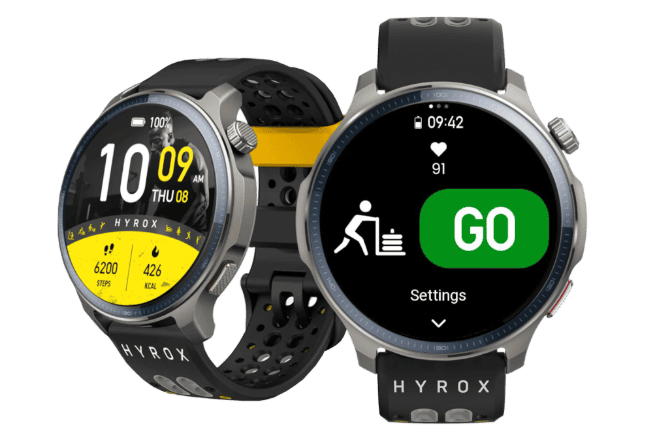



Took a close look at the action during the recent HYROX Race in Hamburg. Selected athletes from the Elite 15 including Linda Meier, Emilie Dahmen and Rich Ryan tracked their performance using Amazfit’s latest sports watches and straps.
On the Edge of the Fourth and Fifth Heart Rate Zones




Dutch athlete Emilie Dahmen made her HYROX debut in fall 2024. At just 19, she delivered an impressive 1h 03m 14s at the Amsterdam event, a performance that instantly placed her among the elite competitors who take on heavier weights. At the World Championships in Chicago this June, she confirmed her potential by finishing 6th with a time of 1h 01m 11s.
Emilie Dahmen during HYROX Hamburg
In Hamburg, Emilie was close to another personal best, missing it by only a few dozen seconds. But the data from her Amazfit T-Rex 3 Pro tells the full story, she fought heroically from start to finish. Just fifteen minutes after the start, every run segment alternated with intense strength challenges: Sled Pull, Farmers Carry, Wall Balls, pushing her deep into the fourth and at times, the fifth heart rate zone, where muscles work under a growing oxygen deficit. Near the end, her heart rate spiked to 189 bpm (Emilie’s HR max is 199).
Linda Meier, the current HYROX World Champion, competed in HYROX Hamburg wearing the Amazfit T-Rex 3 Pro and Amazfit Helio Strap. She started strong, even stronger than in Chicago a few months ago, when she won the championship. Her heart rate was under control, staying within Zone 3 (131–149 beats per minute).
The real challenge began with the Sled Push, followed by the next run where she tried to maintain her earlier pace. Her muscles worked alternately in Zone 4 (150–168 bpm) and the maximum Zone 5 (168–188 bpm) — for about 75% of the entire race.
Rich Ryan, competing with Amazfit Balance 2, showed the same level of determination. The American athlete finished HYROX Hamburg in 55m 01s, earning an impressive 5th place overall.
Like Emilie, Rich spent most of the race — 69% of the time — in the fourth heart rate zone. But his smart pacing early on allowed brief moments of recovery, keeping his heart rate steady and his energy levels controlled. This resulted in a finish that was over two minutes faster than his time at the World Championships in June.
Rich Ryan during HYROX Hamburg
The Key Metrics Before Race Day
Emilie’s promotion to the Elite 15 and Rich’s recent progress are no coincidence. They’re the result of training, experience, and crucially, recovery in the days leading up to the race.
Amazfit wearables such as the Balance 2, T-Rex 3 Pro, and Helio Strap track dozens of metrics across training, post-training and recovery. While all are important, a few stand out as essential before race day, ensuring you’re ready not just physically, but mentally too:
- Time to Fully Recover: Depending on how hard and how long your last session was, recovery time can range from a few hours to a few days. Before the race, aim for this indicator to be close to zero.
- Long-Term Training Load: This reflects cumulative fatigue, estimated from post-exercise oxygen consumption. In the final days before competition, it is best to be at a low or moderate level. After several intense training weeks, it can take over a week to bring this down.
- Training Status: Overloaded, optimal, balanced, energised, or relaxed — this score shifts with fatigue and fitness. During training blocks, “balanced” is ideal.
- Heart Rate Variability (HRV): A key indicator of nervous system recovery. Higher HRV means your body is well-rested and your muscles perform better. HRV drops after tough workouts but rises again with quality recovery, especially after good sleep.
- Sleep Quality: Deep sleep is what matters the most. In an eight-hour night, deep sleep may last just one hour, however, it is the most restorative phase.
- BioCharge Energy Score: Think of this as your internal battery level. It drops during all forms of activity and rises with rest, particularly during sleep. One good night’s sleep isn’t always enough to recharge fully; sometimes, it takes a few days of consistent rest.
Understanding Your Body
Wearable technology does not win races, set records, or even push sleds. But through precise monitoring, it helps athletes understand their bodies and prepare smarter for demanding challenges like HYROX, where most of the effort happens outside the comfort zone.