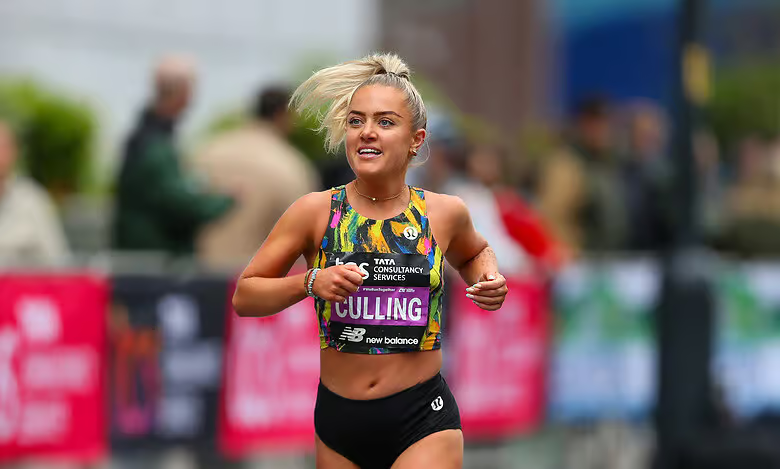

Anya Culling famously stripped two hours from her marathon time – going from running a 4 hour 34 minute debut in 2019 to a personal best of 2 hours 34 minutes just four years later.
But the intense training had a huge impact on Anya’s body. As well as finishing sessions ‘lying on the floor’, she lost her period – a key symptom of Relative Energy Deficiency in Sport, also known as RED-S.


Now the athlete, from Norfolk, says she ‘feels like she could take on the world’ at every start line.
It comes as new research by iron supplement brand Active Iron has found three quarters of women are unaware high training volume can contribute to inadequate iron levels.
Anya, who now lives in London, said: “I didn’t grow up in a family of runners. At school sports day I’d walk. I ran my first London Marathon in 2019 and I vowed to never do it again. But I do remember being really proud of myself at the end.
“Then when Covid lockdown hit, like so many people I started running for my mental health. I remembered the endorphins that one marathon gave me. I had no intention to do another marathon, I just started running and I found solitude and peace in it.”
Due to lockdown restrictions, Anya wasn’t able to test herself against other athletes until the Rome Marathon in 2022, where she was the fastest female European, earning her a place to represent England in Copenhagen.
Anya’s love for running came at a cost, however, and she sought out a new coach after feeling her progress had ‘plateaued’.
She said: “Subconsciously I was under-fuelling and I lost a lot of weight. Then I lost my period. I just thought that was part of being an elite athlete.
“I was so tired all the time, I was dizzy every time I got up. I would have headaches after every session, I would feel so depleted, like lying on the floor and then I’d have no energy for work or life or relationships.
“I just thought that was because I was training hard and that was normal. Now I look back on it and I put too much emphasis on my running and other parts of my life which are more important didn’t get my attention.
“I spoke to a male coach and he said I needed a blood profile and asked if I had a menstrual cycle, explaining it was a huge risk to take me on as an athlete because I would be so prone to injury. So I went on a mission to find a bit more balance. It took me a while.”
Anya sought help from a specialist in sport health and started to supplement with Active Iron and improve how she fuels her body.
The mineral is essential for making red blood cells which carry oxygen around the body.
But certain factors such as heavier periods, vegetarian diets and intense exercise regimes can create extra iron demands which the body struggles to recoup.
Running in particular can create a higher need for iron in the body as the impact of feet hitting the ground can destroy red blood cells in the feet, known as foot-strike haemolysis.
If you don’t get enough iron from your diet it can lead to feelings of tiredness, fatigue and poor recovery.
Anya, now an ambassador for Active Iron’s campaign to encourage open conversations around women’s health in sport, said: “I had no idea that females were disproportionately affected by low iron. I was training with guys and I hadn’t ever discussed particular female differences or anything like that.
“Now I’m trying to eat good food and supplement with minerals and nutrients that my body needs to feel good, including Active Iron. Before I didn’t want to because I didn’t feel like I was training hard enough to warrant them. But I was training hard enough and my body was screaming for them.
“Active Iron has helped me feel like an athlete again – stronger, not weak, and able to perform back at my peak after years of plateau.
“Last year’s London Marathon was my course PB, which I didn’t know I was capable of after a more balanced lifestyle, so I’m excited for the potential for this year’s race.
“I look at old pictures of myself and I look pretty frail. I can see the tiredness behind my eyes and there’s just like no life behind them. Now I feel like I could take on the world. That’s the way I want to be on the start line of any race. I want to be full of confidence.
“I think back to when I had no confidence. I am so proud of myself and I’m proud that I have achieved more than I ever thought I could.”
A recent survey by iron supplement brand Active Iron found that just 25% of women believed high training volume can contribute to inadequate iron levels, while only 27% knew a vegetarian diet can also be a factor.
Meanwhile, 40% of the 1,000 respondents were unaware blood loss through menstrual cycles can also deplete iron levels.
More than half of women who exercised at least four times a week said they had felt unusually tired or lacking energy within the last six months, while 51% said they have experienced headaches and 34% said they had brain fog or difficulty concentrating.
Active Iron are calling on women who regularly exercise to speak up about tiredness and fatigue. Visit https://activeiron.com/en-gbfor more information.