

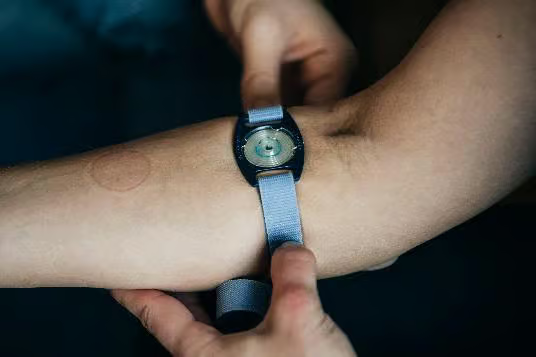

The published research gives the sport science community further confidence in the accuracy delivered by at rest sweat tests
New research released this month has, for the first time, shown the accuracy of sweat testing at rest when compared to sweat testing during exercise.




In a peer reviewed article published in Physiological Reports, the research bridges the gap between what has been seen over the last 15 years of sweat sodium testing using the at rest pilocarpine method (30k+ tests to date), and anecdotal evidence on sodium testing during exercise.
The testing clearly showed that at-rest testing produces significantly similar sweat sodium concentrations to those produced during moderate and high intensity exercise (the intensity at which most athletes do their training).

Chris Harris, the lead author of the research and Sports Scientist at Precision Fuel & Hydration, said: “Sweat testing and personalised hydration strategies are becoming commonplace amongst elite athletes, and those looking to improve their endurance performance.
“The results of this research validate what sports scientists have long suspected, however something that has never been tested in lab based, peer reviewed research.
“The published research gives the sport science community, and athletes, further confidence in the accuracy delivered by at rest tests that can not only be more convenient to fit in around training schedules but are also themselves less susceptible to variation.”
The research tested fifteen well-trained cyclists and triathletes (10 male, 5 female) on multiple occasions both at rest, and during varying intensities of exercise.
The study was undertaken by some of the UK’s leading sports scientists at Precision Fuel & Hydration and approved by the Wayne State University Institutional Review Board.
Chris Harris, added, “This is the first of many research projects we are undertaking to enhance our knowledge and understanding of how optimising hydration and fuelling can benefit endurance performance.
“To contribute to areas of research that are as yet unexplored will only help coaches and athletes better prepare for and perform across a variety of environmental conditions.”
Humans possess an exceptional ability to thermoregulate through sweat allowing us to effectively perform in hot conditions, particularly during prolonged exercise.
However, if unreplenished, sweating can impair performance and even be a danger to our health. Studies have shown that even 1%–2% body mass loss can impair endurance performance.
Sodium is the primary electrolyte lost in sweat, which also plays a key role in maintaining plasma volume, fluid retention, and neuromuscular function during exercise.
Past research has shown that there is a significant variation in both sweat rate and the concentration of sodium in an individual’s sweat. These variations are largely influenced by genetic factors and therefore are known to remain consistent over time.
Sweat sodium and sweat rate testing have become increasingly common enabling personalised hydration strategies. Methods to induce sweating include pharmacological (e.g. pilocarpine) stimulation, passive heat exposure, and exercise.
Patch testing during exercise is the most common technique used to collect sweat samples and has the advantage of generating information under highly sport-specific conditions. However, issues with patch contamination or evaporative loss of sweat from patches can skew results.
Pilocarpine iontophoresis is a technique that induces localised sweating via electrical stimulation, and is considered an accurate and reliable, non-invasive method for measuring sweat sodium.
It is widely used in clinical diagnostics of conditions like cystic fibrosis and has gained popularity in sports science for its ease of use under resting conditions, meaning testing can be conducted in any environment without impacting an athlete’s training requirements.
However, the extent to which pilocarpine-induced sweat sodium reflects that of exercise-induced sweat sodium has, until this research, remained unclear.
The results of this latest study clearly showed a good level of agreement between at rest pilocarpine-induced sweat, and sweat collected during moderate and intense exercise.
Chris Harris, the author of the research and Sports Scientist at Precision Fuel and Hydration, added: “We entered into the research to further our understanding around different sweat collection and analysis techniques that are currently being used.
“The results clearly show that at-rest sweat testing generates information on sodium losses with an accuracy that would allow for a finely tuned hydration strategy to be developed.
To read the full research paper, visit Comparison of pilocarpine‐ versus exercise‐induced sweat sodium concentration across exercise intensities in trained athletes
For more information about the research, and at rest sweat testing, visit Precision Fuel & Hydration


