

How did the athlete prepare and perform in the race of a lifetime?
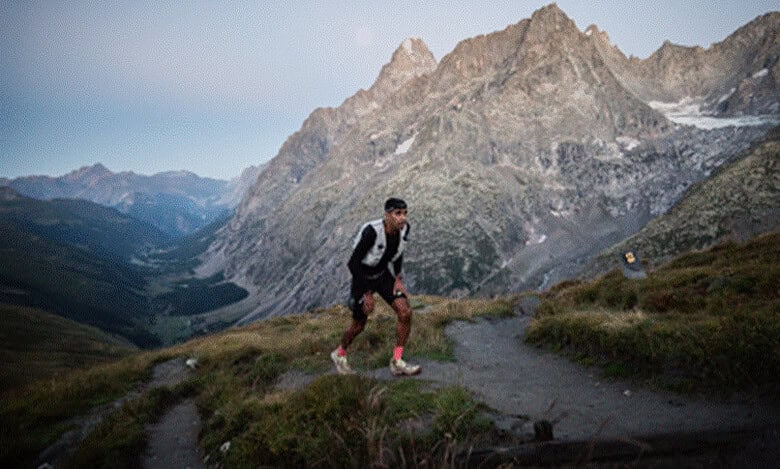
Ben Dhiman on the UTMB 2026 course.



Ben Dhiman, the crowned winner of the 2026 UTMB race uses Amazfit sports technology in his training regime and on race day, to best optimise his performance. We take close look at Ben Dhiman’s training and race data recorded by his Amazfit Cheetah 2 Ultra and take a deeper look into how it resulted in his first-place finish last weekend.
Race Preparation: More mileage, less intensity
For a long time, UTMB Mont-Blanc seemed just out of his grasp. Despite intense and lengthy preparations, the athlete failed to finish the race in both 2023 and 2024. It was not until his third attempt, in 2025, that he succeeded, finishing second, in 19 hr 51 min 37 sec. For many athletes, such a result would have been a dream come true. Not for Ben Dhiman. He wanted more. He wanted to be first. And that is exactly what he achieved last weekend.
Ben Dhiman’s preparations for this year’s UTMB followed a similar structure to his effort in 2025. His training consisted of three consecutive blocks lasting five to six weeks each, but the volume of his training sessions increased significantly. In January alone, he logged 107 hours of training. In February and March, the figures were 95 and 105 hours, respectively. He had never trained at such a high volume before.
Amazfit Cheetah 2 Ultra on Ben Dhiman’s wrist
The same pattern continued in the following months. During the final 12 weeks, Ben Dhiman maintained a training volume 30% higher than during the corresponding period in 2025. At the same time, he cut the number of high-intensity sessions in half.
A few days before the start, the American explained the thinking behind this change in approach during an interview with fellow Amazfit athlete Rod Farvard at the Amazfit Hub in Chamonix.
Race Preparation: How Ben Dhiman trained
July offered a good example of what this looked like in practice.
- 12,000 m of elevation gain each week
- Sessions including:
- Long mountain runs (5–6 hours)
- Hilly gravel runs (2–3 hours)
- Easy runs on flat terrain (1–1.5 hours)
- Uphill runs on a treadmill (1–1.5 hours)
- Up to two strength-training sessions.
Overall, according to the Training Balance feature available on the Amazfit Cheetah 2 Ultra, more than 20% of his preparation consisted of strength training, while 80% was endurance training.
Ben Dhiman’s short and long-term fatigue levels. Data from the Amazfit Cheetah 2 Ultra, July 2026
In the final weeks before the race, his training moved onto the trails around Chamonix. One of his last hard sessions took him from Chamonix to Courmayeur over 75.17 km. Along the way, he accumulated 4,519 m of elevation gain, completing the run in 8:18:14 with an average heart rate of 134 beats per minute. Beyond another long day spent in the mountains, the session gave him an opportunity to train on the terrain where he would soon race with one final chance to see how his body would respond to the demands before beginning his taper.
“The biggest challenge at UTMB is extreme fatigue. It changes your perception of reality. It makes everything difficult. That’s why you have to train under high, prolonged loads, repeatedly, so that you become accustomed to making decisions and maintaining efficient movement despite mounting fatigue,” Ben Dhiman explained.
Race Day: Finding his own rhythm
Following an intense training period, the athlete arrived at the start line early on Friday morning for the most famed race in the trail running calendar. After setting off at 7:45pm, Ben settled into the long mountain race.
During the first eight hours of the race, his heart rate rose above 170 beats per minute four times (his maximum heart rate is 185 beats per minute). This happened whenever he faced long climbs. The longest took him from an elevation of 800 m above sea level to more than 2,500m. This data was tracked via his Amazfit Cheetah 2 Ultra and viewed on Zepp app.
Elevation profile recorded by the Amazfit Cheetah 2 Ultra
During the race, he took the lead after the 40-kilometre mark, with 75% of the distance remaining of the technical 168k race. The race featured long climbs, technical ascents and variable weather conditions throughout, with decisions made early in the race having long term impacts on later stage of the run around the Mont Blanc Massif.
If the route were adjusted for elevation gains of almost 9,700 m, Ben Dhiman’s average pace during his winning UTMB effort would be equivalent to 4:51/km. Further data tracked and recorded by his Amazfit Cheetah 2 Ultra illustrates the scale of this extraordinary effort.
Ben Dhiman crossed the finish line after 18 hr 16 min 41 sec of racing. His legs had carried him over a course on which 56% consisted of climbs, with a total elevation gain of 9,686m. Yet finishing first among 2,400 runners was no coincidence. It was the result of a journey far longer than the route around the Mont Blanc massif.
Post Race: Looking at the data
Ben Dhiman closely monitored his heart rate. As he later explained, during such a long race, heart rate does not always have to reflect the actual level of exertion. When the American, who trains in France year-round, crossed the finish line in Chamonix, his Cheetah 2 Ultra showed 9,911 calories burned —, equivalent to roughly three days’ worth of calories for an adult man.
His average race pace was 6:27/km, while his grade-adjusted pace, as shown by the Cheetah 2 Ultra, was 4:51/km. That approach was enough for him to steadily build a lead over the rest of the field.
At 80 km, Ben Dhiman had a lead of around 19 minutes. At 104 km, it had grown to 22 minutes, and at 127 km to 28 minutes. In Vallorcine, around 20 km from Chamonix, the second-place runner was now more than half an hour behind.